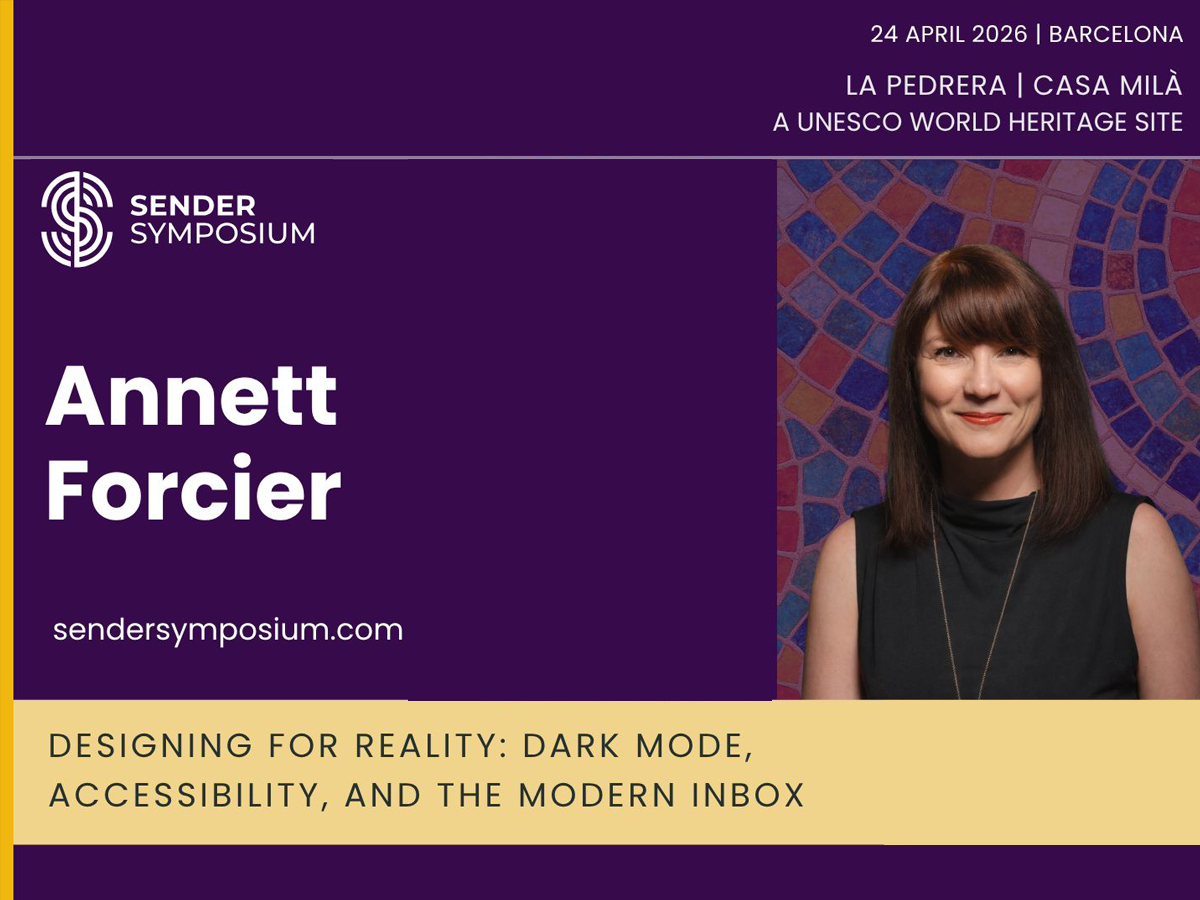
Last month, I had the opportunity to speak at Sender Symposium in Barcelona — a practitioner-led event built for people who take email seriously. Hosted at the iconic La Pedrera (Casa Milà), the symposium brought together leaders in email, CRM, lifecycle marketing, deliverability, and messaging infrastructure for a focused day of practical discussions, working sessions, and peer-level conversations.
What made the event especially refreshing was its format.
No expo floor.
No vendor theatre.
No passive listening in a dark room.
Instead, Sender Symposium was intentionally designed as a high-interaction working conference where operators, strategists, developers, and marketers could openly discuss the realities of modern messaging.
My presentation, Designing for Reality: Dark Mode, Accessibility, and the Modern Inbox, fit perfectly into that spirit because it focused on something many teams are quietly struggling with right now:
The growing gap between what we design — and what subscribers actually see.
One of the core ideas behind the presentation was simple:
If our emails aren’t readable, they won’t perform.
That sounds obvious. But many teams are still reviewing emails in ideal conditions — desktop Gmail, light mode, controlled environments — while a large portion of subscribers experience something entirely different.
Today, email clients increasingly reinterpret designs on behalf of users:
Dark mode has become one of the clearest examples of this reality.
According to the data shared during the presentation:
This means a significant portion of subscribers are seeing a transformed version of your campaign — whether you designed for it or not.
One of the biggest misconceptions in email is the idea that dark mode automatically improves user experience.
Sometimes it does.
But in email specifically, dark mode often introduces entirely new accessibility problems:
During the session, I showed real-world examples of emails rendered across different clients. The same email behaved dramatically differently in Gmail, Apple Mail, Outlook, and Samsung Mail. In some cases, unsubscribe links became nearly invisible. In others, brand colors shifted into unintended tones. CTA buttons that looked strong in one client appeared broken in another.
This is where accessibility and performance become inseparable.
If a subscriber struggles to read your email, trust drops. Engagement drops. And eventually, performance drops too.
One of the most important points in the presentation was this:
Email clients — not designers or developers — ultimately decide how dark mode is applied.
Apple Mail is relatively respectful and supports intentional dark mode styling through prefers-color-scheme.
Gmail often overrides or adjusts colors unpredictably.
Outlook behaves differently depending on version, platform, and user settings — which means there is no single “Outlook experience.”
The result is that one carefully designed email can render in completely different ways across a subscriber base.
That unpredictability changes how we need to think about email production.
One thing I appreciated about Sender Symposium was how grounded the conversations were.
The event positioned itself as “a better room than the internet” — and honestly, that felt true. Instead of generic growth hacks or surface-level marketing trends, the discussions focused on the operational realities behind lifecycle messaging, deliverability, customer experience, and scalable email systems.
There was a shared understanding in the room that modern email is no longer just about beautiful mockups or campaign volume.
It is about:
That made discussions around dark mode and accessibility especially relevant because they sit right at the intersection of design, engineering, and customer experience.
One of the strongest themes throughout the talk was that dark mode issues are rarely solved at the coding stage alone.
The real work happens much earlier:
This is especially important because most drag-and-drop ESPs still provide very limited control over dark mode behavior.
Instead of relying on last-minute fixes, teams need to stress-test visual assets from the beginning.
Some of the practical recommendations I shared included:
One phrase from the presentation became a recurring theme:
“If it survives in isolation, it survives in the email.”
That mindset changes everything.
Another concept that resonated strongly with the audience was the idea of applying mise en place to email production.
In professional kitchens, mise en place means everything is prepared before service begins.
Email teams should work the same way.
Instead of treating dark mode as a post-launch bug-fixing exercise, we should:
When teams do this:
That is where modern email operations need to move.
What made this topic especially meaningful for me is that accessibility in email is still often misunderstood as a compliance checkbox.
But accessibility is much broader than screen readers alone.
Readability.
Contrast.
Visual hierarchy.
Consistency across environments.
These are all accessibility concerns. And in the modern inbox, dark mode stress-tests all of them simultaneously.
As email professionals, we are no longer designing static layouts.
We are designing systems that need to survive unpredictable rendering environments while still maintaining clarity, trust, and usability.
That is the real work.
Sender Symposium was an incredible experience, and I am deeply grateful to everyone who attended the session, shared perspectives, and contributed to the conversations throughout the day.
Barcelona itself added something special to the event. The symposium took place during the broader Festival of Email week and just after Sant Jordi — one of the city’s most beautiful cultural celebrations centered around books, roses, and storytelling.
It felt like the perfect backdrop for a conference built around thoughtful discussion, real practitioner insight, and a genuine passion for the craft of email.
The conversations confirmed something important:
The industry is ready to move beyond “perfect mockups” and start designing for reality.
And honestly, that is where email gets interesting.
📩 Connect with me on LinkedIn or send a message.
With Love from Barecelona
Annett
Founder, EmailBoutique.io